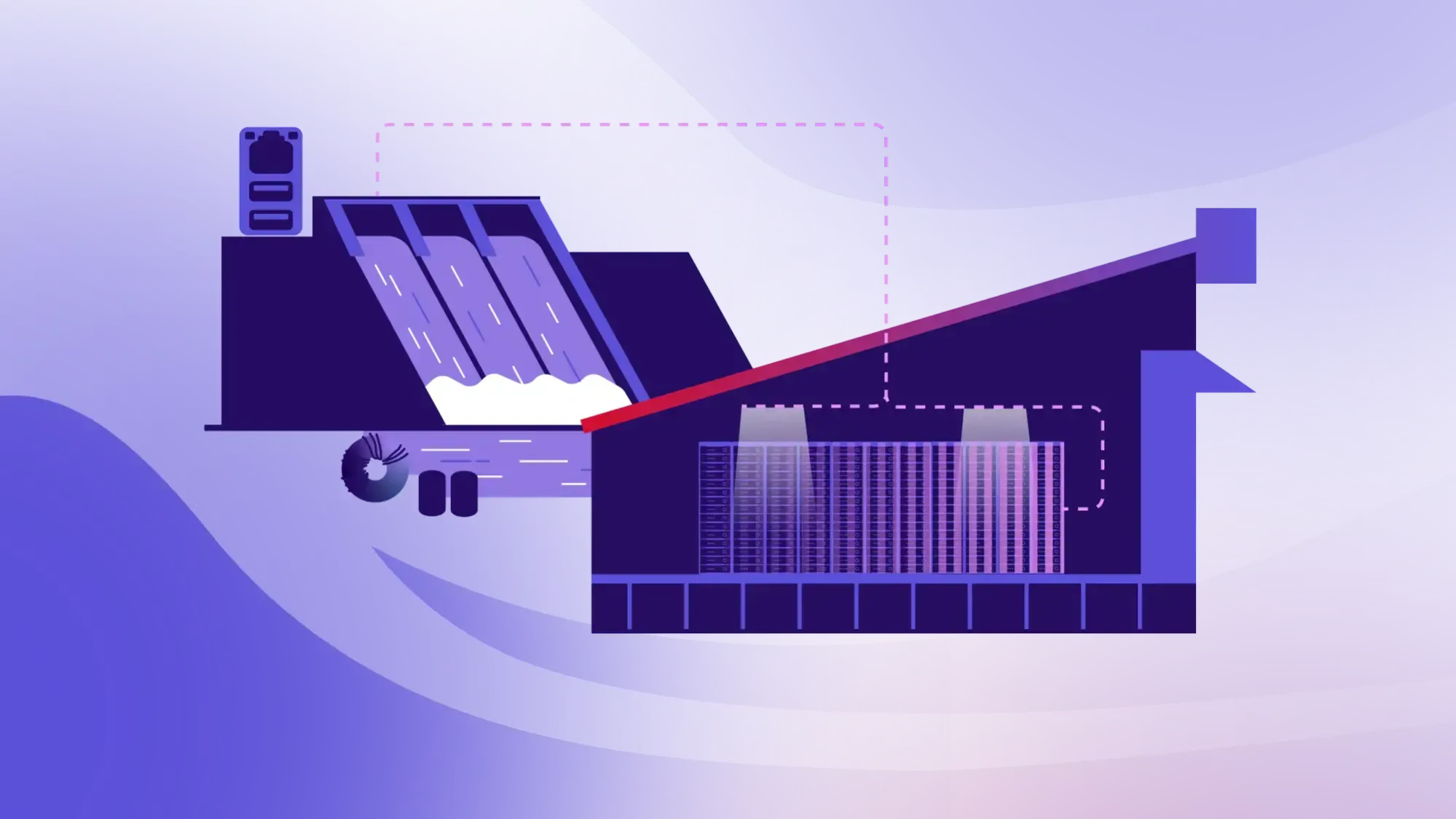
Without electricity, nothing runs in a data center: from the servers to the building’s technical infrastructure. From an environmental perspective, it is important to know where the electricity comes from and where we can save it. We source the electricity for our German and Finnish data centers with 100% renewable energy certificates (Guarantees of Origin). That leaves the question of where further savings are possible. A data center’s PUE value provides one answer.
In this article, we take a closer look at how this value is calculated and what it actually means.
What does PUE mean, and what does it measure?
PUE stands for “Power Usage Effectiveness” and describes how efficiently a data center uses energy. The value shows how much energy a data center needs in total for one kilowatt hour (kWh) to reach the IT systems. The formula behind it is refreshingly simple:

The perfect value would be 1.0. In that case, every kilowatt hour would flow directly into IT, with no additional energy needed for operations. In practice, however, that is impossible. Air conditioning units, UPS systems, transformers, power distribution, and lighting also need energy; and losses inevitably occur during operation.
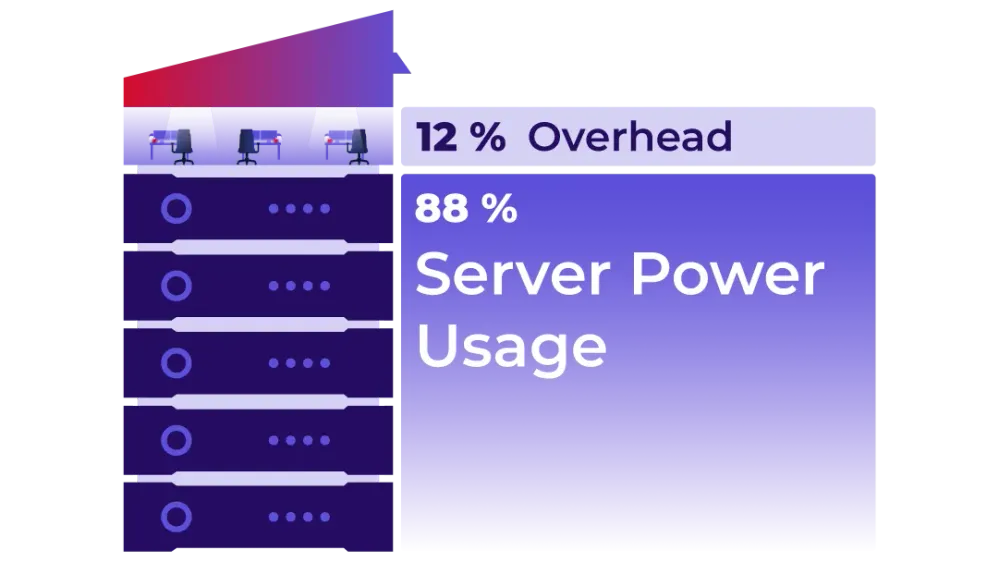
We call the portion that does not reach IT "overhead". The smaller the overhead, the closer the data center gets to the perfect 1.0, and the better the PUE.
What does this mean in concrete terms for us? Our data center park in Nuremberg used around 55 GWh of electricity in 2025. With a PUE of 1.12, this means that for every kilowatt hour flowing into IT, the rest of the infrastructure needs only 0.12 kilowatt hours. In other words, around 89% of the electricity goes directly into the servers.
For comparison, the German industry average was 1.46 in 2024. With the same IT load, a data center like that uses around a third more electricity than one with a PUE of 1.12. The electricity saved could power around 5,000 average German households for a year.
One important note: PUE says nothing about how efficiently the IT itself operates. You can read about how we operate our servers as efficiently as possible in our article on sustainability.
Side fact: Back in 2011, TÜV SÜD measured a PUE of 1.1242 for our park in Falkenstein. According to TÜV SÜD, this was the lowest value it had measured up to that point. The industry average at the time was still around 1.8. (Source: TÜV SÜD)
How is PUE measured?
To make the PUE value truly comparable, we need to measure power consumption precisely. We cannot treat it as a snapshot. One cool week would distort the picture. That is why we measure over the full year, so that all four seasons and their different temperatures are included.
For this, we measure consumption in strictly separate categories:
- IT consumption: servers, storage, network
- Building/infrastructure consumption: cooling, power distribution, lighting, security
We measure in accordance with a specific standard, DIN EN 50600-4-2. It defines how providers should measure and calculate these values so they can compare them objectively. This also allows us to meet the requirements of the German Energy Efficiency Act (EnEfG).
How does Hetzner keep PUE so low?
First of all, we do not achieve this low value by making one single, especially effective decision. It results from a combination of many technical measures and an extremely efficient infrastructure, from the building itself to all supporting systems.
The key to a low PUE value lies in making non-IT infrastructure as energy-efficient as possible and avoiding unnecessary losses.
We can divide these areas roughly into three groups:
- Cooling
- UPS (uninterruptible power supply) and power distribution
- Other building functions: lighting, security systems, access systems, monitoring, administration
If IT power consumption increases while infrastructure energy consumption remains constant, the PUE decreases. The smaller the gap between IT consumption and total consumption, the better.
Free air cooling: The biggest driver of a low PUE
Our cooling concept is where we perform particularly well. Instead of energy-intensive cooling technology, we use the most economical cooling medium available: outside air.
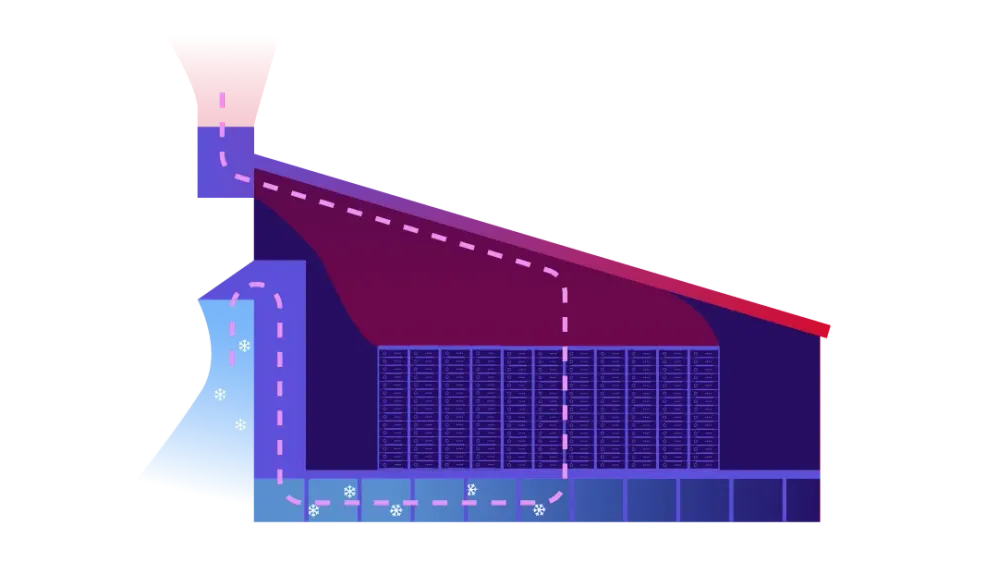
This is how it works: The data center draws in cool outside air through air shafts on the facade, guides it through cold aisles and raised floors directly to the servers, and keeps warm and cold air strictly separated. The heated air then leaves the building at the highest point of the roof — which is also why we have our iconic sloped roof design. Apart from a few fans, this requires very little electricity.
We do not simply send all of the warm exhaust air outside. We use part of it to heat office spaces, which saves additional energy.
We do not use water-based cooling, such as dry coolers or evaporative coolers at all. This saves water and also eliminates several power-hungry components that account for a large share of overhead in other data centers.
On particularly warm days, air conditioning units can switch on as a supplement. Depending on the location, year, and climate conditions, however, they only run on a few days per year. As a result, their share of power demand is usually around 3 to 7 percent, and no more than about 10 percent at most. This is one of the main reasons for our extremely low PUE.
UPS with 99% efficiency: Minimal losses in power distribution
For the power supply, we rely on very short cable routes and modern UPS systems with a high efficiency of up to 99%. This is also a top-tier value compared with the industry average. We therefore keep electrical losses as low as possible.
The fewer transformers and conversion stages there are, the less energy is converted into unusable waste heat. Thanks to the compact, modular design of our data centers and our high rack density, we need less infrastructure per kilowatt of IT power. This further increases efficiency.
Efficient building structure: Less infrastructure, better PUE
This category shows the intelligent planning we put into our data centers. We consistently design our buildings to maximize efficiency, starting with the architecture. Our design focuses on what is technically necessary and leaves out any superfluous, energy-intensive systems. The building structure itself also helps minimize energy losses and simplify operations.
This allows us to avoid lighting large unused areas, operating complex ventilation or air conditioning systems for ancillary rooms, and maintaining unnecessary technical infrastructure. Lighting is active only where we need it. We have minimized the energy footprint for our buildings’ security, access control, and monitoring systems.
We install all technical systems in a way that makes maintenance, repairs, and later replacement straightforward.
92% utilization: Why high load improves PUE
One final factor is utilization. Across all locations in Germany and Finland, our average utilization is around 92%, an exceptionally high value. This has a direct positive effect on PUE. Why? The formula is:
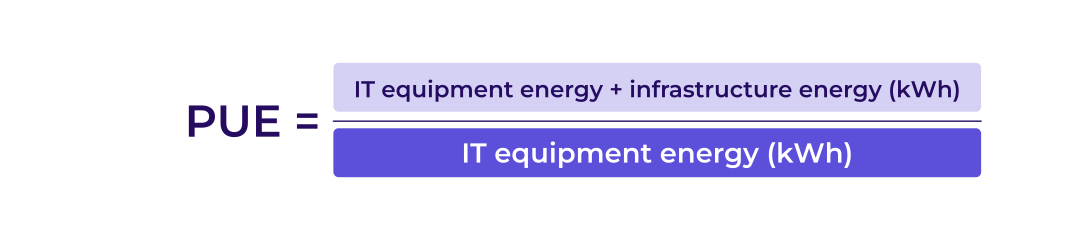
High utilization therefore ensures that the existing infrastructure is used optimally and that the PUE value decreases. In other words, a well-filled hall operates more efficiently than one that is half empty.
Conclusion: Efficiency is a matter of consistency
We show that well-planned architecture, smart cooling, and a clear technical approach can achieve enormous savings. The PUE of 1.12 is the result of a system designed correctly from the ground up.
At the same time, we continue working toward an even more efficient future. New technologies, optimized cooling, and a consistently streamlined building layout will continue to increase efficiency in the coming years.