Imagine arriving at work in the morning, starting your PC, and wanting to check your emails. Then you notice that your account has been locked. At first, you assume it is a technical issue. But then you learn your provider has suddenly denied you access.
Could you still continue working? Or would everything come to a standstill for the time being?
This situation leads to a fundamental question: How dependent are you on the services of large tech providers? In most cases, this kind of dependency only becomes obvious when a service is no longer available.
This is exactly where digital sovereignty comes in.
What Is Digital Sovereignty?
Digital sovereignty means making conscious decisions about digital dependencies, maintaining control, and acting independently.
This affects the entire digital infrastructure: from providers, manufacturers, and platforms to software, operating systems, storage locations, access rights, and contractual terms.
But sovereignty does not mean that you have to become as self-sufficient as possible and run all your own servers in the basement. Cloud services, email providers, software platforms, and internet hosting providers take a lot of work off your hands and make many things easier. Digital sovereignty starts when you understand the consequences of your choices.
Example AI: how dependent are you already?
US providers are flooding the AI market and tying companies and private users to their services. By now, almost every larger company has an “Enterprise” subscription for its preferred LLM tool. But there are three points you should look at more closely.
First, the model: Does it run openly and locally, or do you depend on a closed API that the provider can change, make more expensive, or shut down at any time? Second, the data: What happens to your prompts? Do they end up in the next training run? And third: How deeply have you already integrated the tool into your workflows? And how easily could you move away from it again?
You act sovereignly by weighing these consequences. For a harmless question, the convenient service is perfectly fine. However, for sensitive company data, you may prefer an open model that you operate yourself on your own or rented infrastructure. You give up a bit of convenience, but you keep control over where your data is processed and who can read along.
In other words, you choose your dependencies deliberately, reduce risks, and keep control over your digital infrastructure.
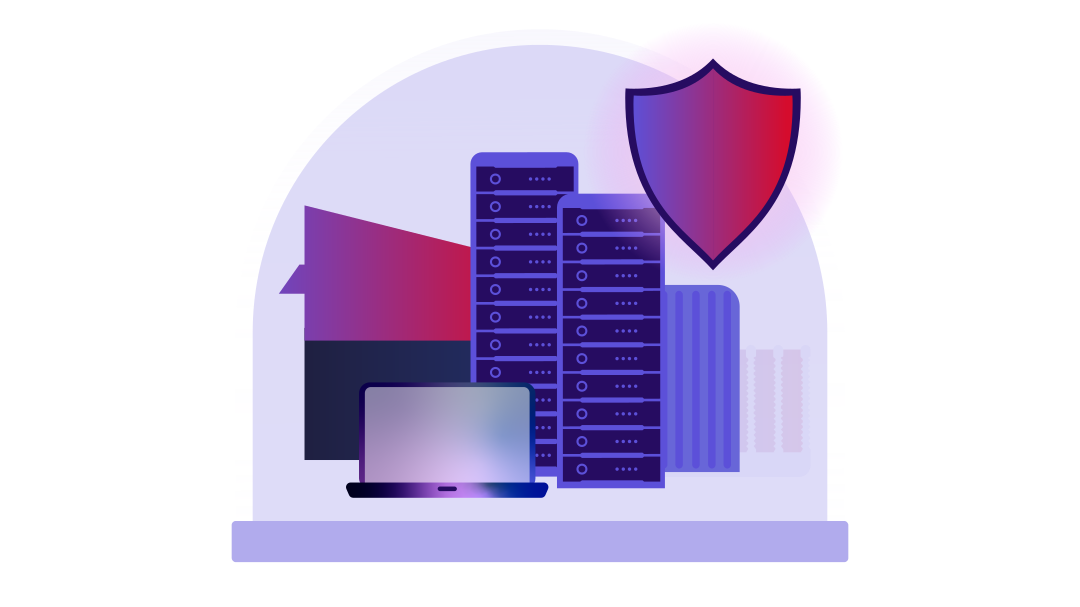
How to put true digital sovereignty into practice
Our guide
The following questions show you what to pay attention to. Being able to answer and document them is already an important first step:
1. Where is your data stored, which legal jurisdiction applies to your provider, and how transparently does it operate?
The storage location matters, but it is not the only deciding factor. You also need to know which legal jurisdiction your provider falls under and which legal access rights this may create — even across national borders. A sovereign approach requires you to understand security standards, data protection measures, certifications, contractual terms, and changes.
2. Who operates your systems, and how secure is your data?
Digital sovereignty means knowing who has access to data and limiting who has access to it through permissions, encryption, clear contracts, and transparent organizational and technical safeguards from both you and your hosting provider. It also matters who actually operates and administers your systems — and whether your operations can remain functional if a provider becomes unavailable.
3. Which software, platforms, and technologies do you use, and how dependent are you on them?
The key question is whether you choose your infrastructure consciously or gradually become dependent on individual vendors, proprietary interfaces, or closed ecosystems without noticing it. The keyword here is vendor lock-in. This describes a situation in which a provider ties you to its ecosystem and switching involves significant technical, organizational, or financial hurdles. If you cannot switch today, you may have made the wrong decision yesterday.
These three questions all come down to three closely connected levels: the legal jurisdiction of your provider, the infrastructure you choose, and the software you use.
Digital sovereignty means making conscious decisions about digital dependencies, maintaining control, and acting independently.
'/%3e%3cdefs%3e%3clinearGradient%20id='paint0_linear_2385_12941'%20x1='0.699951'%20y1='14.82'%20x2='37.3'%20y2='14.82'%20gradientUnits='userSpaceOnUse'%3e%3cstop%20stop-color='%235C50D9'/%3e%3cstop%20offset='1'%20stop-color='%23D50C2D'/%3e%3c/linearGradient%3e%3c/defs%3e%3c/svg%3e)
Why legal jurisdiction matters
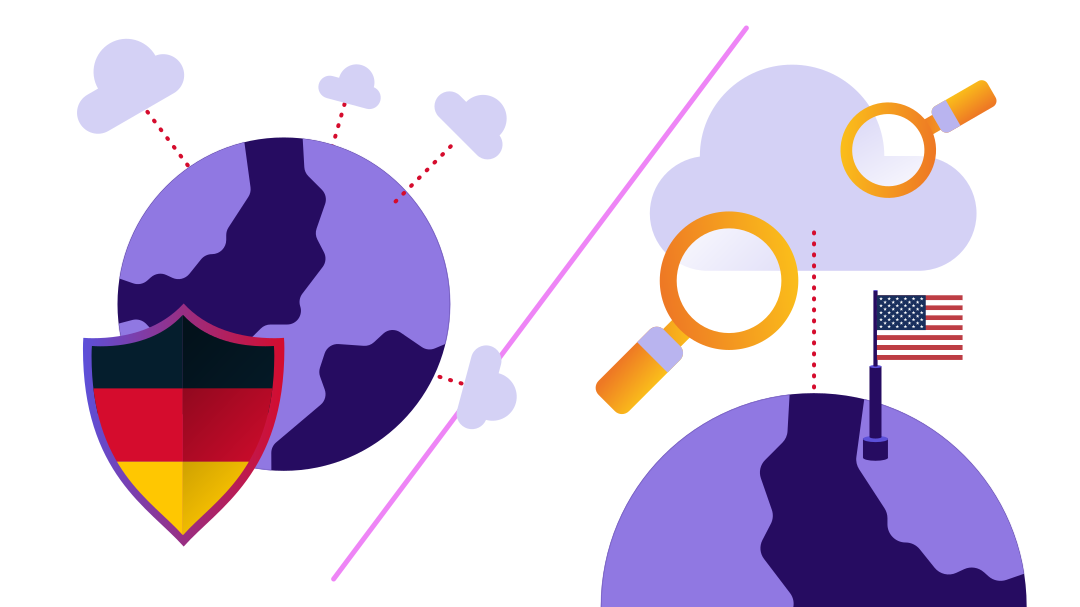
In Europe, the General Data Protection Regulation (GDPR) has applied since 2018. It protects personal data and gives you clear rights. For example, you have the right to know what happens to your data and what it is used for. At the same time, the GDPR defines the obligations that companies and other organizations must meet when they process personal data. That creates a solid foundation. Of course, this is not absolute: under defined legal conditions, courts or authorities can still request access. The difference is that this happens within a known framework, with clear rules and limits. So the legal order your provider falls under decides who can reach your data — and how.
US CLOUD Act
Outside Europe, different rules often apply. In the United States, for example, there is no single, comprehensive data protection law like the GDPR in the EU. And then there is the CLOUD Act: It requires US companies to provide data to US authorities if a court order exists. What makes this relevant is that the law can also apply if an American provider operates a data center in Europe. A European subsidiary alone does not necessarily change that. What matters is the jurisdiction of the parent company.
Strong infrastructure creates security
Laws alone are not enough. It matters just as much who operates the IT infrastructure — meaning the servers, networks, and data centers where your data is stored.
A good provider does more than just keep servers available. It also transparently documents where it physically stores your data, which security measures it puts in place, and how it protects access to your data. This includes clear responsibilities, documented processes, access controls, encryption, and verifiable security standards. Without secure IT infrastructure, there can be no digital sovereignty.
These features point to a trustworthy provider
Recognized certifications are a good first indicator. They show that an independent body has audited the provider.
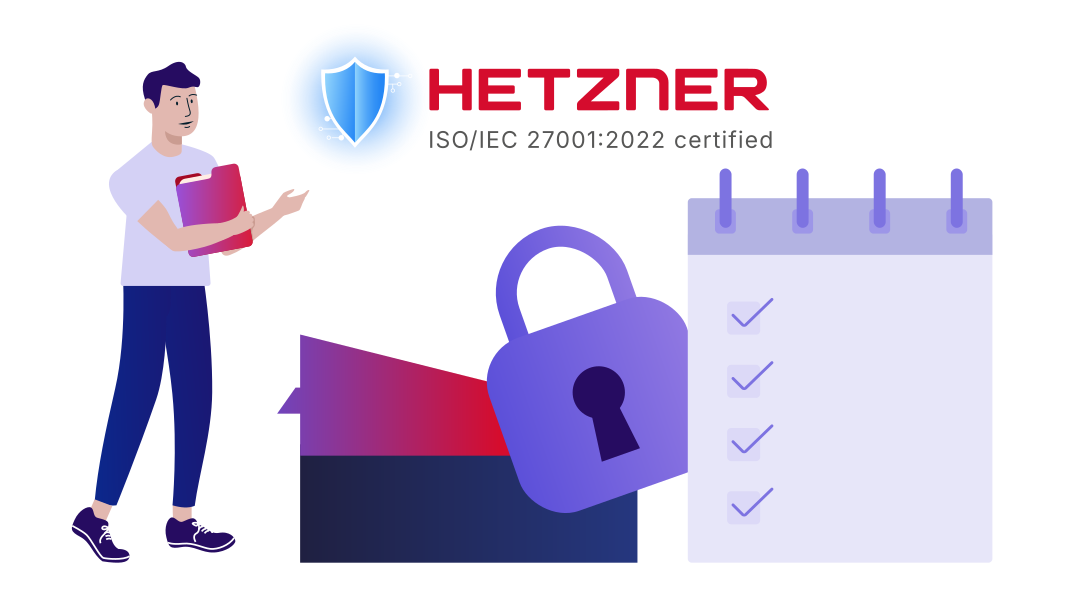
ISO/IEC 27001:2022 is an important foundation. It confirms that a complete information security management system (ISMS) is in place. This includes regulated access, protective measures for the infrastructure, and processes for secure operations.
A C5 attestation goes one step further in terms of security. The Cloud Computing Compliance Criteria Catalogue was developed by the German Federal Office for Information Security (BSI) and defines minimum requirements for secure cloud computing. It is an important form of assurance, especially for public authorities and sectors with high security requirements. Our dedicated, managed, and cloud servers, as well as our web hosting, storage, and colocation offerings, meet the requirements of this catalogue.
Sovereignty with the right software
European law and trustworthy data center operators are already worth a lot. But there is a third level: software. Which programs do you use? Which systems do your applications run on? And how easily can you switch?
Software plays a major role in how independent you remain in the long term. If data, workflows, and interfaces are tightly bound to a closed system, switching can become difficult. This applies, for example, to office and collaboration tools, email systems, customer databases, shop systems, or internal management softwareore control with open source
One way to gain more independence is open source software — and not just because these services are often free.
Open source means that anyone can view, use, and further develop the source code. This creates transparency and makes you less dependent on individual vendors. It also gives you a better understanding of how the software handles data.
You no longer have to rely on a single company to maintain a product or continue serving you at all. Typical examples include Linux instead of Windows, Nextcloud instead of Google Drive, and Matrix instead of WhatsApp.
AI also offers this path: You can use an open model together with an interface such as Libre WebUI, which feels similar to familiar chatbots. The important distinction here is between the model and the service. You can run an open model like DeepSeek yourself. But if you use the provider’s ready-made app, the provider runs the service on its own servers, and its legal framework applies. You only gain real sovereignty when the model runs on your own or rented infrastructure. This way you decide in which country your data lives.
These are the questions you should ask yourself: Which tools are essential? Where are there sovereign alternatives? And where do you consciously accept a dependency because the benefit outweighs the risk?
Deploy your own AI workspace
In our step-by-step guide, you'll learn how to host your own AI platform on a rented GPU server.
Sovereignty comes from concious decisions
Digital sovereignty does not mean hosting everything yourself or cutting yourself off from the digital world. Running your own servers gives you maximum control, but it also creates maximum effort. For most people and organizations, that is neither realistic nor necessary.
At the other end of the spectrum are large, convenient platforms and cloud services. They are often technically powerful, easy to use, and widely adopted. It is easy to lose sight of critical, essential information: Who can access your data? How easily can you leave if you want to switch? Can your provider legally sell your data to third parties? When you look at US providers, the legal framework also plays an important role — not just the physical storage location.
For many, a European hosting provider therefore offers a sensible middle ground. Not because it automatically solves every problem, but because it often gives you a clearer legal framework, more transparency, and better conditions for control.
Whether you ultimately choose a fully European solution or a mix of several providers, one thing matters most: make your decisions consciously.