The year is 1997: The internet is still in its infancy, and the first companies are discovering the enormous potential of this new technology. In a quiet town in Bavaria, an electrical engineer also recognizes that the times are changing: Martin Hetzner founds a company with the goal of making internet technology accessible to everyone.
That vision leads to Hetzner’s first self-built servers, later to entire data centers, and eventually to large data center parks and locations on three continents with more than 450 employees.
From the very beginning, Martin Hetzner is convinced that long-term planning beats short-term goals. Nearly 30 years later, it has become clear that he was right.
1997: How it all began in Gunzenhausen
In the late 1990s, web hosting was still a hurdle for many small and midsize businesses. Having their own website promised visibility, new customers, and a path into the digital future. But the specialized hosting industry as we know it today was still in its early stages. Anyone who wanted to go online needed technical know-how, their own servers, or outside help.
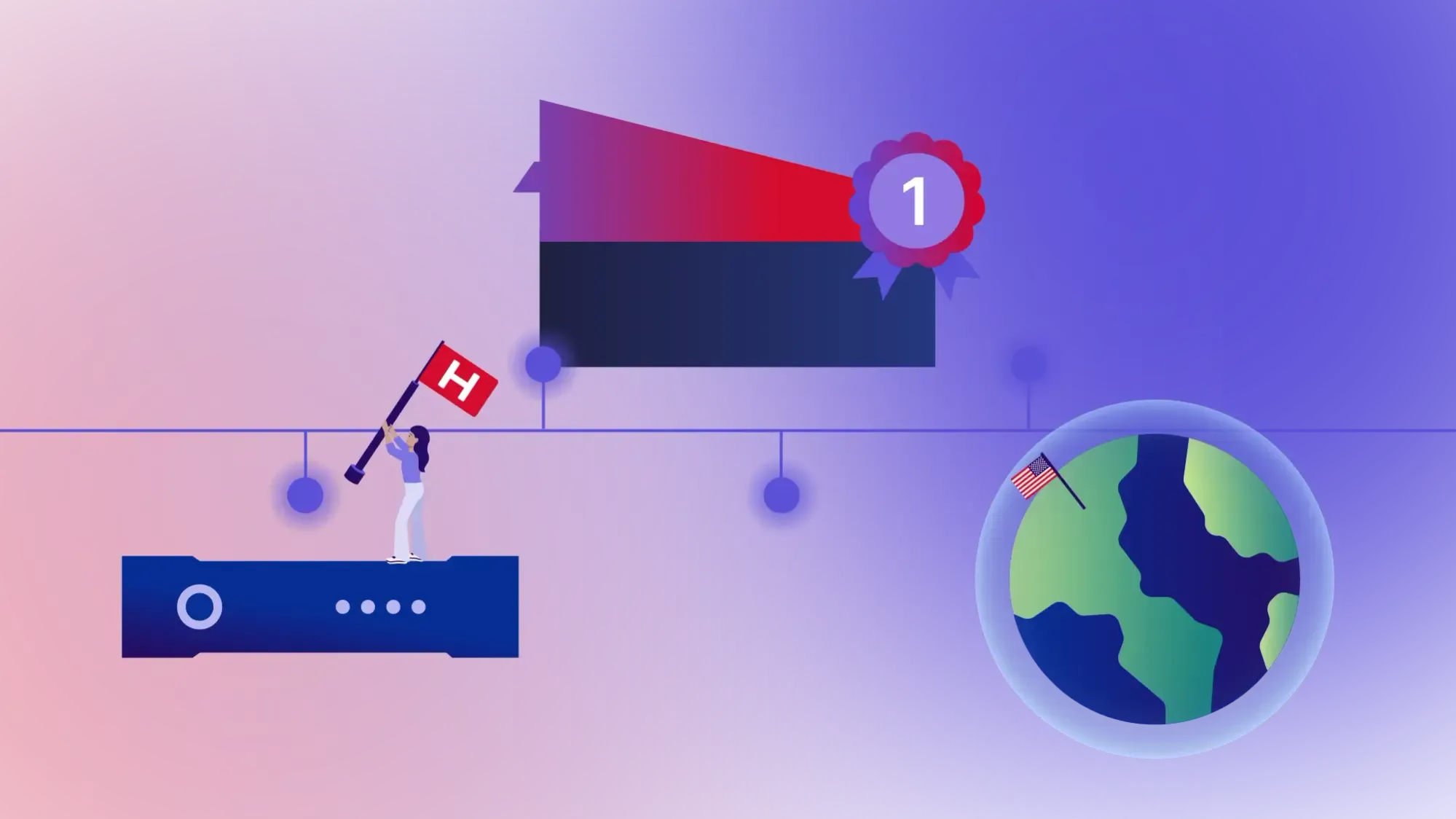
Martin Hetzner saw the opportunity. He started out by reselling servers from the United States. Using these servers, he provided hosting products that made it easier for companies to run their own websites. He felt that web hosting should not be reserved only for large companies with their own IT departments.
Even then, the aspiration that still runs through our work today began to take shape: We want to offer technical solutions that are powerful, affordable, and easily accessible. At the same time, we do not want to chase short-term trends; we want to plan for the long term.
In the years that followed, Martin Hetzner expanded the company step by step. Demand increased, the infrastructure grew, and the first Hetzner offering developed into a technical ecosystem of its own.
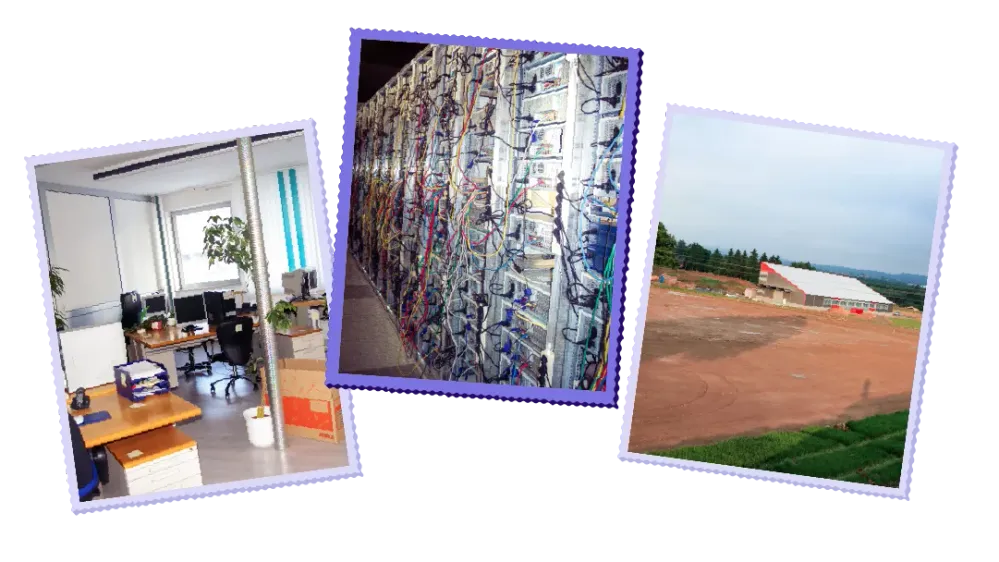
The first Hetzner data centers and our own servers
In the early years, we continued buying and reselling server capacity. But the more demand grew, the clearer it became: Anyone who wants to offer consistently good prices and stable performance over the long term needs more control over their own infrastructure.
So we began developing our own servers and becoming less dependent on existing solutions. Efficiency became our guiding principle, and it remains one of the core principles of our work today.
The then existing capacity was soon no longer enough. That is why, in 2001, we rented our first data center in Nuremberg, right in the middle of the city. Four more followed in the years after that.
By 2008, we were hosting 200,000 domains worldwide and providing 20,000 servers. Hetzner was no longer a small hosting provider; it had become one of the largest in Germany.
At the same time, we reached a new limit: In rented data centers, we could influence power supply, cooling, building design, and network connectivity only to a limited extent. We wanted to improve exactly those areas.
Our own data center parks in Falkenstein and Nuremberg
In 2008, we began constructing our first self-designed data center park in Falkenstein in the Vogtland region; we bundled multiple data centers together on one campus, with infrastructure we built based on our own ideas.
We planned the entire location, which we opened in 2009, from the ground up. And although we have certainly improved upon our design since then, many of our original design elements remain. From the start, we focused on sustainable solutions for power supply and cooling. In Germany, 100 percent of our electricity still comes from hydropower. And outside air helps us cool our servers efficiently. We designed the buildings with pent roofs and high raised floors so that we could direct air through the server areas in a targeted way. Monitoring systems provide security, and our self-designed servers ensure maximum energy efficiency. We did not want to leave anything to chance.
Nuremberg followed in 2011: Here, too, we built a data center park based on the same principles. On roughly 40,000 square meters, we created space for up to ten data centers, which we built step by step. When we opened the site in 2012, we already operated 60,000 servers and employed 140 people.
Around 15 years after Martin Hetzner founded the company, the “Bayerns Best 50 Award” recognized us as one of the fastest-growing companies in the state of Bavaria. And growth continued: Within just two years, we doubled our server capacity to more than 150,000 systems.
C-Lion1 and the path to Finland
After Falkenstein and Nuremberg, we turned our attention northward. We recognized Finland's potential. Its cold climate is ideal for cooling servers with outside air. Because of its location, the country is an important link between northeastern and western Europe. Add to that the favorable electricity prices. So in 2015, we began planning a data center park in Tuusula, about 20 kilometers from Helsinki.
That same year, we invested in the C-Lion1 submarine cable. The roughly 1,100-kilometer fiber-optic cable runs through the Baltic Sea and connects Rostock with Helsinki. It enables fast, low-latency data transmission between central and northern Europe, with a bandwidth of 120 Tbit/s.
The cable went into operation in 2016. At the same time, we started building the park, drawing on our many years of experience from Falkenstein and Nuremberg. Our start in Finland shows how we understand expansion: We do not simply want to get bigger; we want to build locations where they make technical and strategic sense.
The cloud arrives!
In 2018, we introduced the Hetzner Cloud. Dedicated servers remained an important part of our portfolio, but many customer projects now needed more flexibility. For the first time, Hetzner customers could launch cloud servers within seconds, adjust them flexibly, and pay for them by the hour. This lowered the barrier to entry for test environments, web applications, and development projects.
For us, it was the logical next step in the development of our infrastructure: We made internet technology even simpler and accessible to even more people.
The scale of demand became clear quickly: In the very first year, we provided 100,000 cloud instances.
USA: The leap across the Atlantic
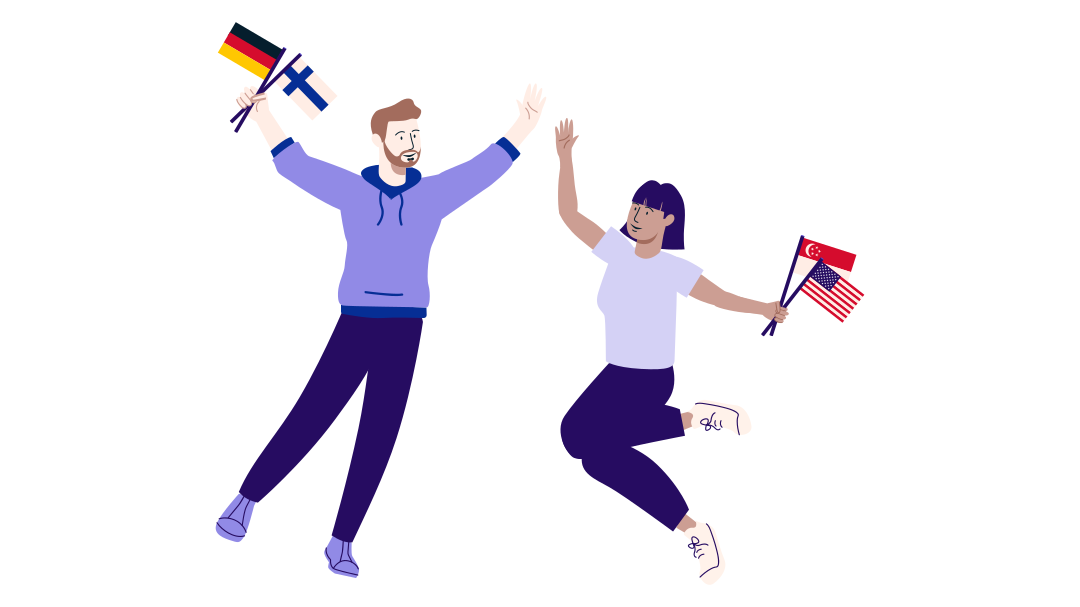
In 2021, we opened our first location in North America, in Ashburn, Virginia, one of the most important internet hubs in the United States. Since then, we have served the North American market with cloud servers from the East Coast.
Just one year later, we added Hillsboro, Oregon, on the West Coast. With this east-west presence, we significantly reduced latency for North American customers. At the same time, international users could now distribute their workloads across Europe and North America, increasing the resilience of their systems.
During this phase, we operated around 350,000 servers and employed more than 400 people. The provider from the small town of Gunzenhausen had become an international infrastructure partner.
25 years of Hetzner
Throughout all those years of growth, we have owed our success, above all, to the people behind Hetzner. Many of them had already been part of the company for decades. Their knowledge, experience, and support for the company formed the foundation of our progress.
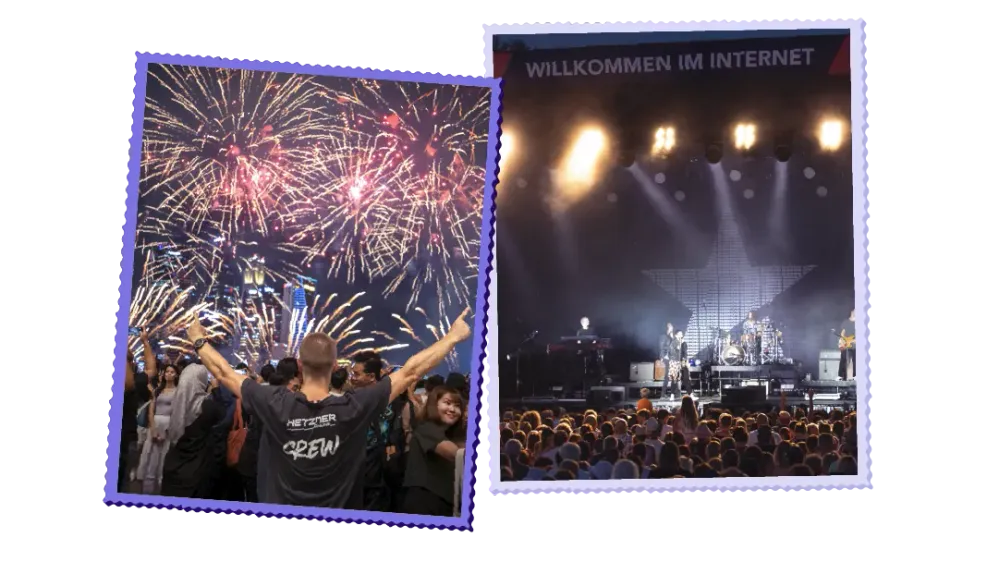
For our 25th anniversary, we, therefore, wanted not only to look back, but also to give something back. At our main location in Gunzenhausen, we invited around 5,000 visitors to a free open-air concert. After the local opening band Good Weather Forecast opened, the well-known pop/rock group Silbermond played as the headliner.
After 25 years, we looked back with pride on what we had built together.
Arrival in Asia and the first Hetzner Summit
In 2024, our expansion reached the next continent: With Singapore, we opened our first location in Asia and have offered cloud solutions there ever since.
Thanks to its strong connectivity to growing markets such as China, Japan, and India, Singapore is an important building block in our global presence.
We also marked another first in 2024: the first Hetzner Summit in Falkenstein. We invited prospective customers to the Vogtland region. They explored the data center park on site, got a look behind the scenes, and spoke with us directly.
The program included DC tours, panel discussions, expert talks, and a relaxed get-together. We provided food, drinks, and entertainment, including tech talks, a gaming corner, and live music.
One million active cloud instances
In 2025, we reached another milestone: For the first time, more than one million cloud instances were active at the same time — seven years after we introduced the Hetzner Cloud. Our dedicated systems also stayed on a successful trajectory: At that point, we were operating more than 500,000 server units — and demand showed no signs of slowing down.
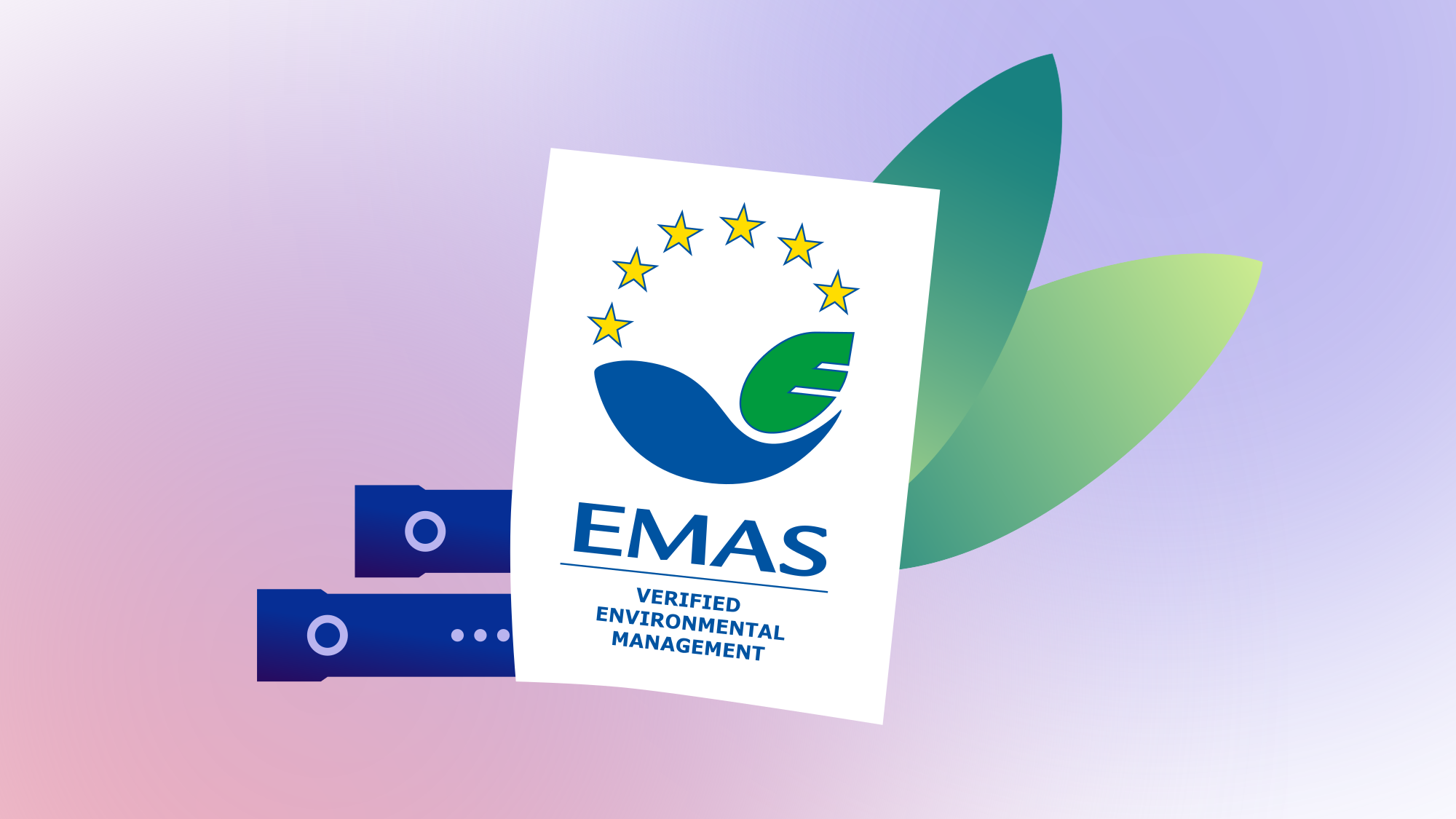
The more our infrastructure grows, the more important it becomes for us to handle resources consciously. That is why, in 2025, we introduced a comprehensive environmental management system with EMAS certification. EMAS stands for Eco-Management and Audit Scheme — a system the European Union developed so that companies can systematically review, improve, and transparently document their environmental performance.
And the story continues
Hetzner's story began with the internet, and it is far from over. We remain true to our values and continue to steadily develop our offering, whether through improved GPU servers for AI applications or the expansion of our cloud offering.
We have already set one project in motion: We are building a new company headquarters in Gunzenhausen, with room for further growth and a modern working environment.
And in 2027, Hetzner will turn 30. After our last anniversary concert with Silbermond, the bar is high, but we will celebrate our anniversary appropriately in 2027 with an open-air concert — that much is certain.
We have come a long way from our first web hosting offers in 1997 to the international company that we are today. Yet one idea runs through our history: We build infrastructure that is powerful, efficient, and accessible. We have been working on that since day one, and that is exactly what we will continue to do.