At Hetzner, we still take “do-it-yourself” very literally. We develop our own software, design our data centers ourselves, and build most of our servers in-house. If we ever find ourselves missing small parts while building a server—whether it’s brackets or air ducts—well, then we just print them ourselves.
Our latest “DIY” project is 3D printing. We’ve now produced more than 100,000 parts and have no plans to stop.
Find out what’s behind this and what a former butcher shop has to do with it in this article.
Why we print server parts ourselves
What exactly do we print? And does it make sense? The short answer: thousands of components for our servers, and yes, it’s worth it. The long answer is:
When building and operating our data centers, we place a high priority on efficiency—especially when it comes to cooling. Our servers run around the clock and constantly generate heat that needs to be dissipated. We rely on what is likely the most environmentally friendly option: fresh air. It flows through the systems, absorbs the heat from the components, and circulates it out in a targeted manner. To ensure this process runs cleanly and efficiently, we need effective air ducts. And since we build many of our servers ourselves, we require custom-made solutions for this.
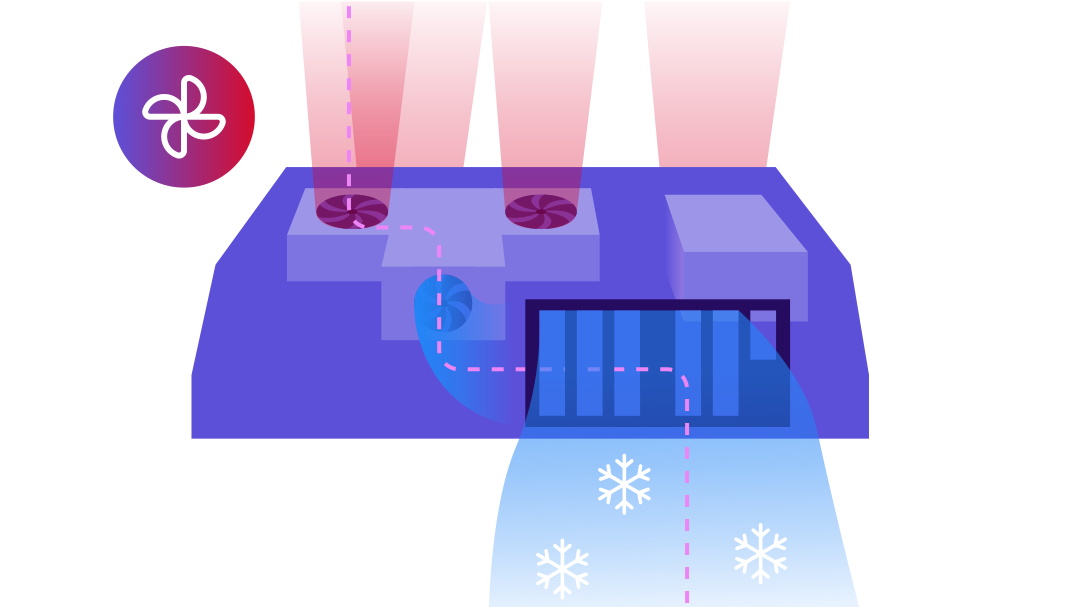
This is exactly where 3D printing comes in. It produces precision-fit parts that meet our strict requirements. And not just for airflow through the air ducts—we need other custom components to secure cables and install hard drives. We develop, design, and print the small parts ourselves instead of ordering them through a long and expensive process—it’s simply more efficient. This eliminates long transport routes and supply chains—so we also help the environment.
The 3D printing department launched in mid-2025 at our hardware manufacturing facility in Gunzenhausen. Our 3D production team works together with our main production facility in Falkenstein, where we build our dedicated servers, which we then ship to our locations in Germany and Finland. The print farm is thus located right at the source.
But how does an idea turn into a finished component?
From prototype to series production
First, we check whether a part is even suitable for 3D printing. So far, this has included over 20 different air ducts and many other small parts. They’re ideal because they don’t have to withstand extreme mechanical stress, have simple geometric shapes, and are only exposed to temperatures of up to 80°C.
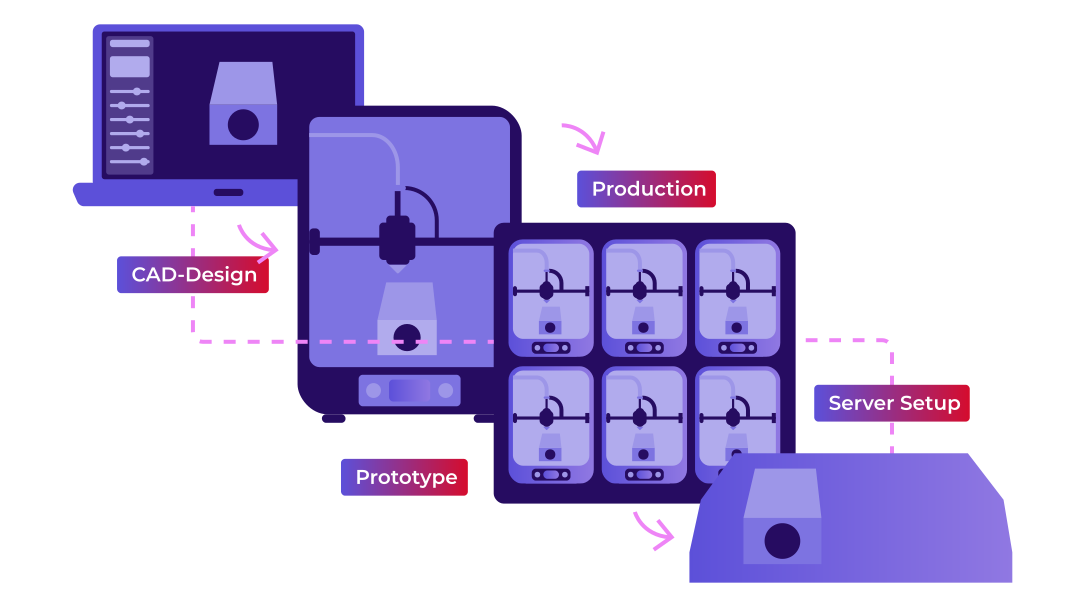
Once we decide we want to produce a component ourselves, we move on to modeling and thus to development. To do this, the team creates a virtual model in our CAD software. CAD stands for “Computer-Aided Design” and describes a common category of software used to create and edit 3D models. The practical advantage of this is that we can see right on the screen, to scale, whether everything fits together.
Then we print a prototype and test it in a real server. If something isn’t right, we correct the model and print it again. Once the component fits, we move on to product development. If the team there gives the thumbs up, series production begins.
The creative team in the 3D printing department is constantly testing and experimenting with new components. The need for customized solutions is as great as the variety of our servers.
Our print farm in constant operation
Mass production? How is that supposed to work? By building several hundred servers every day, we must need just as many parts printed, right? Exactly. That’s why we need brackets and air ducts on this scale—and we need them every day.
At first, we only had a handful of printers at our disposal. That has since grown into a full-fledged print farm with more than 40 machines. But we’re certain it won’t stop at 40.
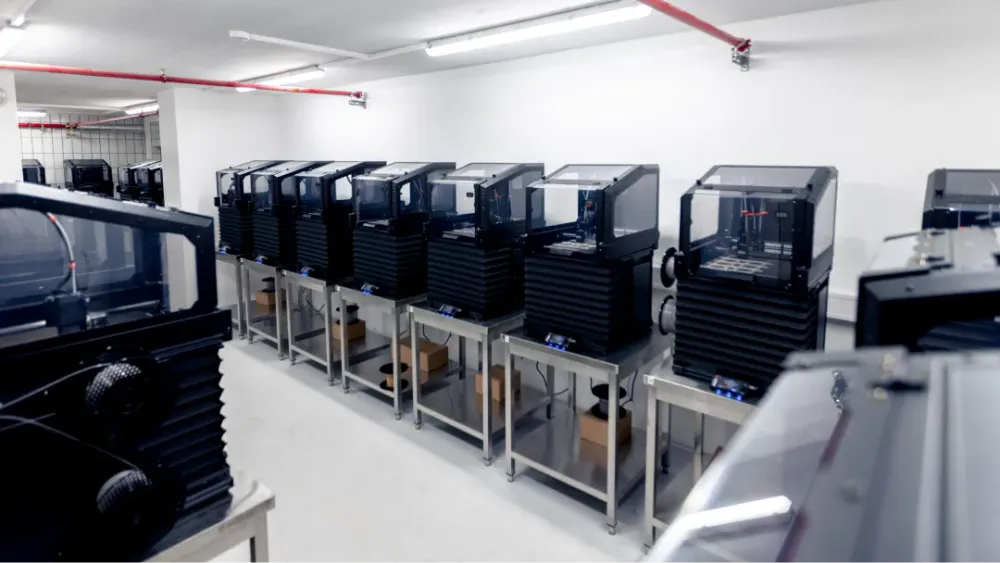
If you're wondering about the tiles on the wall: Our print facility is located in a former butcher shop that used to be part of a supermarket. Why build a new building when we can use existing spaces creatively and sustainably?
To keep up with the enormous volume of orders, the machines run an average of 20 hours a day, seven days a week—sometimes even up to 24 hours. The output is impressive: We produce 1,000 air ducts per week. To do this, we use about half a ton of filament per month. Filament is the plastic thread that the printer melts and applies layer by layer. For the material, we rely on PETG, a robust plastic that can withstand enough heat. Since the servers are in operation 24/7, the interior can get very hot.
The technology behind the Prusa XL fleet
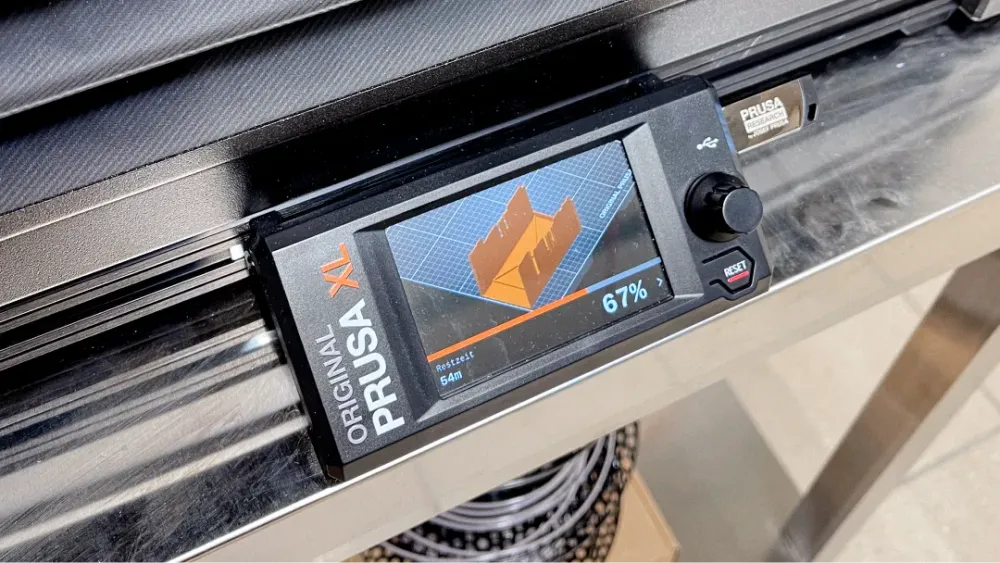
We chose a Czech FDM printer, the Prusa XL. FDM stands for Fused Deposition Modeling and describes exactly the principle mentioned above: The printer heats the filament and extrudes it layer by layer through a fine nozzle until the part is complete. On the Prusa XL, this nozzle is just 0.4 mm wide.
Each printer has two print heads, each with a filament spool. When one spool is empty, the second print head seamlessly takes over, so that, in the best-case scenario, you don’t have to change spools or intervene in any other way. Each printer uses about two spools per week, or roughly four kilograms.
To prevent the machines from interfering with each other due to vibrations, each printer sits on its own table.
The 360 x 360 x 360 mm build volume offers plenty of space. This allows us to print air ducts in one piece without having to assemble individual parts. A typical duct, for example, measures 150 x 100 x 96 mm. Since we utilize the entire build volume, we print four to six air ducts simultaneously, depending on their dimensions.
Another practical feature is that we can fine-tune many settings: from nozzle and heated bed temperatures to layer height and print speed. It took us a while to find the ideal settings for our parts, but it was well worth the effort.
More than just an experiment
If it doesn’t fit, we make it fit—even if it has to come straight from the 3D printer. This saves us time and money and makes us less dependent on supply chains. Plus, we can produce parts that might not even be available for purchase.
The future potential is huge: The question is no longer whether 3D printing works, but how we can make our components even more robust and our processes even more stable. What’s particularly exciting for us is seeing which materials, print profiles, and automation options will make its use even more efficient in the future. Maybe one day we’ll even print larger server components in one piece—who knows.
The fact is: 3D printing is no longer an experiment at Hetzner but an integral part of our production.